

How To Prevent Injuries And Recover from Handstands Training

This article is all about the recovery and maintenance of your body while training for handstands.
If you want to be good at handstands, you need to be smart. Learning to handstand should not start with handstands. Far too often I see “newbies” trying to kick up to handstand with little or no awareness of alignment or how to control the body/muscles. Handstand is an upper-body-dominated discipline. Therefore we need to take it easy and listen to our bodies, even though we may feel like we are not progressing fast enough. If you get injured, your progression will be much slower, if you are not on your hands at all.
The main goal to share this knowledge is that our handstand practice should be pain-free throughout our handstand journey. Prevention is key! We want to be able to practice for years to come. Remember, listen to your body. Don’t overdo when it comes to work on handstands.
Notice: I am not a medical professional and all the following tips are based on my own experience. Please seek professional medical help to be sure you are doing the right thing.
Common Understanding for Handstands Training
- Don’t skip the warm-up and cool-down even if you don’t have enough time. Better you shorten your training and MAKE time to do both for each session.
- If your joints and connective tissues start to feel stressed or in pain, back off. Don’t practice over your pain. Instead, work on flexibility and mobility during the de-loading phase. Backing off doesn’t necessarily mean you don’t practice at all. You would dial down on high-difficulty drills and begin moving toward your easier/lighter routines like a warm-up and stretching where your weakness is for mobility.
- You will want to work on the straddle, splits, and pike position with the ability to get your legs towards the chests for the good press to handstand. Work on hamstrings or hip flexors stretches instead of heavy-load on your hands.
The most COMMON INJURIES in handstand practice
- Wrist pain
- Elbow pain
- Shoulder pain -Rotator cuff tendonitis
Again, Handstand practice is an upper-body-dominated training. Your wrists, and shoulders cannot bear too much load and volume of handstand training in general. Discomfort is fine, pain is not good. Don’t practice over the pain. Because connective tissues adapt slower than muscles, as you get stronger, fast progression or a high volume of training may be too much for your connective tissues, even if your muscles can handle the workload. DO NOT IGNORE the signal of your body.
As I mentioned earlier in this article, prevention is very important for handstand training. The reason why you should have pain or injury is you most probably rush for the result and overdid for your body.
I will go through how to recover from handstands and why recovery is important. Volume, how much total you are doing, and prevention of injuries are the key. We all need to recover well and want to be able to practice for years to come.
Trouble Shooting Common Handstand Issues
- Ramp up slowly your handstand training. Be easy on volume and load.
Never skip the warm-up for the nervous system can do the right things. Progressive overload is the concept of systematically and gradually increasing the intensity and volume of the warm-up routines. Take the time to warm up properly before every single session. This allows you to develop a better connection between blood circulation, the nervous system to the brain, and muscles which will result in better physical performance. The intensity of the warm-up activity includes the range of motion, force, and velocity of movement. The cool-down is also an important part of handstand practice for healthy quick recovery from each training session. To make handstand practice a habit of your daily life without any pain or discomfort, stretch after the handstand practice as well. Both warm-up and cool-down are necessary activities. - Don’t overuse your wrists and shoulders no matter which level you are in handstand practice, listen to your body. As soon as the training is too much for your body, the body gives you a warning signal. Don’t ignore those signals. For us, it is difficult to stop practicing because we are too addicted to handstand. But it is super important to know when to back off. Backing off doesn’t necessarily mean no training, it is more about knowing how to modify or reduce the training to avoid certain stressors where the pain occurs before too late. This applies to both beginners and more advanced ability levels for the higher workload. Handstand practitioners tend to be addicted to performing better and more, resulting in some nagging overuse injuries. Be careful of a slight signal from your body. If you are accustomed to a regular training schedule, a forced rest, which I call “De-loading” can be quite beneficial. De-loading is an art. The goal is to compensate without losing the adaptations you have gained by increasing the amount of rest you are allowing yourself. Just make sure you find something to do with your extra time and energy. I switch to core, lower body strengthening workouts to keep myself on a healthy track. I love moving, jumping, running, squatting, etc. Very often I realize the body had a great opportunity to heal and re-generate for a new start when I get back on my routine for handstand practice. I feel just good and energized. Last but not least, don't go back to your normal routine volume, increase the volume slowly after de-loading.
Mobility Work
Take this time to work on the mobility of other body parts which is not a pain-affected area. Mobility work will promote healing, and it is much better to keep moving than completely resting. The blood circulation through your body will help regenerate your injured area and your tendons will be worked very lightly, which will not aggravate them further.
This will allow any needed recovery process to take place and assess your body before the pain turns into a serious injury. Decrease volume and don’t work through the pain.
Overuse tendonitis gets worse if you continue to perform exercises that aggravate it. Listen to your body. Continual aggravation of an injury will significantly hinder your training. After you substitute an offending workout for another or drop down a progression, you can always move back into it as your condition improves.
How long for recovery
One to two weeks of mobility work should clear up mild tendonitis because the initial inflammation will promote healing. This does not mean you have to stop working out. Just avoid exercises that aggravate the overused area where the tendonitis is present.
Conclusion
Be Smart
Always try to leave a little bit space in the tank so that you can come back stronger tomorrow. Sustainable training is not about smashing yourself into the ground and breaking your body. We are here to train, learn, move, grow, and feel better about ourselves. If you know you are injured, continuing to train like you were before the injury is not very smart. Back off, take some time to rest, and allow your body to heal before you go adding further stress. I know, it sucks, but being smart about it will help you recover much faster and then start making progress again. Work on core strength, mobility, and flexibility instead beating your body. A healthy handstand practice strategy is a combination of good warmups and recovery work and knowing how to modify the training when you feel something is off.
For Intermediate - Advanced Practioners
Handstand skills to advanced level are measured in years, not weeks or months. It's a journey that takes a lot of dedication and commitment to get right. Whenever you see someone performing a quality handstand, just stop comparing with yourself and appreciate how long they have been practicing to achieve this. This is the number one thing you should be doing to take care of your body and stay healthy and strong.
I hope, this article could offer you some useful ideas for preventing handstand-related pain and injuries.
Please feel free to comment with any questions or feedback on the blog. I am happy to hear from you. Enjoy your handstand journey!
For an absolute beginner to the handstand, I have an ultimate beginner’s press handstand online program: see the program.
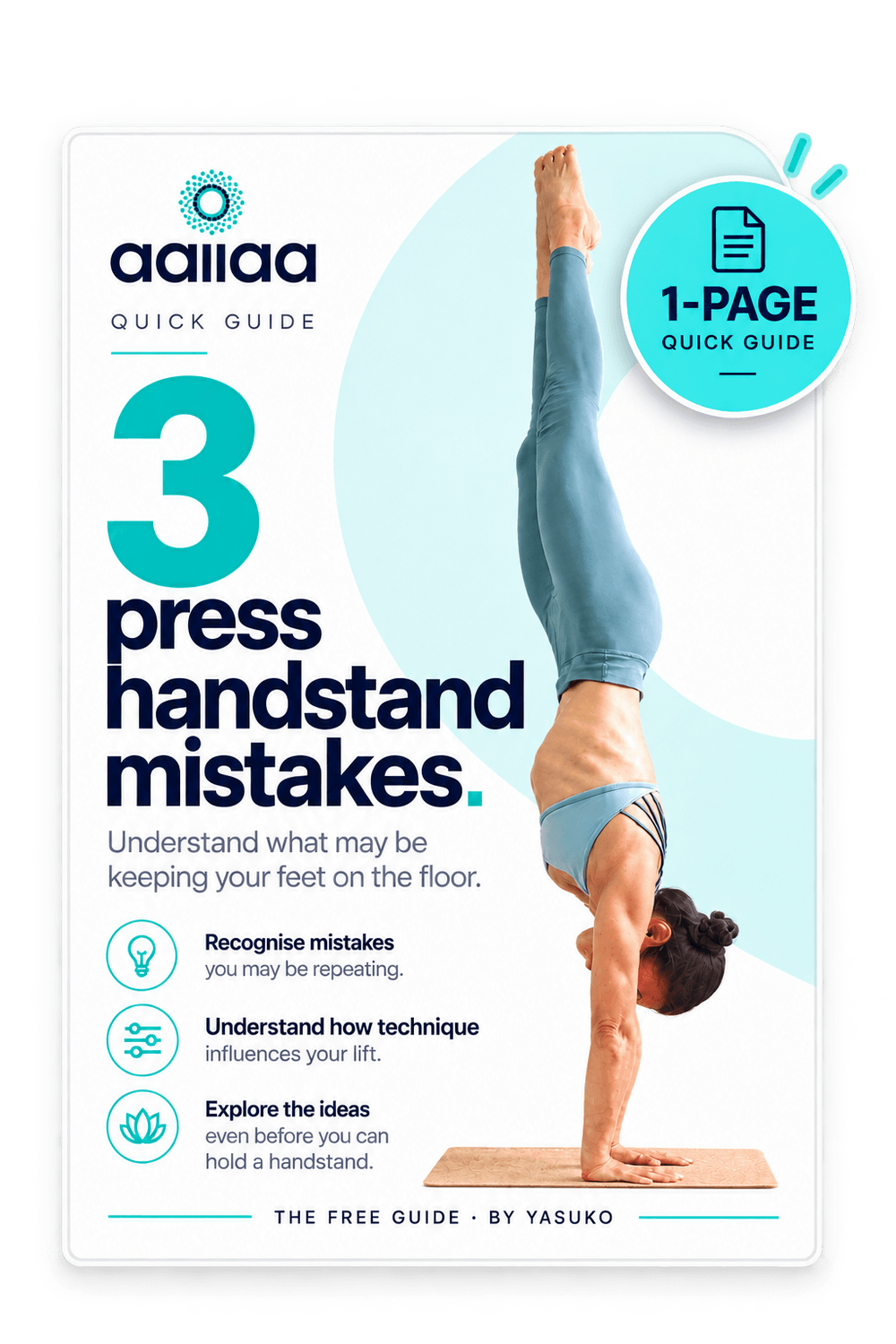
3 Press Handstand Mistakes
Get my free 1-page quick guide and see what may be keeping your feet on the floor.
Get the free guide →
Hi, I'm Yasuko
I teach the press handstand step by step – to students in over 30 countries.
Ready to learn the press?
My complete online program, from first lean to full press.
See the program →HEY, I’M AUTHOR…
... lorem ipsum dolor sit amet, consectetur adipiscing elit, sed do eiusmod tempor incididunt ut labore et dolore magna aliqua. Ut enim ad minim veniam, quis nostrud exercitation ullamco laboris nisi ut aliquip ex ea commodo consequat. Duis aute irure dolor in reprehenderit in voluptate velit esse cillum dolore eu fugiat nulla pariatur. Excepteur sint occaecat cupidatat non proident, sunt in culpa qui officia deserunt mollit anim id est laborum


JOIN MY MAILING LIST

Created with © systeme.io